Manufacturing costs, scalability, lead times, and product quality often come down to one critical decision: production volume.
For Canadian manufacturers, OEMs, startups, and industrial buyers, choosing between low volume and high volume CNC machining can directly affect profitability, operational efficiency, and product success. A production strategy that works for a prototype may become too expensive at scale, while large-scale manufacturing can create unnecessary risks for early-stage products.
That’s why understanding the difference between low volume vs high volume CNC machining is more important than ever.
According to recent manufacturing industry reports, the global CNC machining market is projected to surpass $140 billion by 2030, driven by rising demand for automation, precision engineering, and scalable manufacturing solutions. Canadian manufacturers are increasingly investing in advanced CNC technologies to improve production efficiency and reduce supply chain dependencies.
Whether you’re launching a new product or scaling an established one, selecting the right machining approach can save time, reduce waste, and improve long-term manufacturing performance.
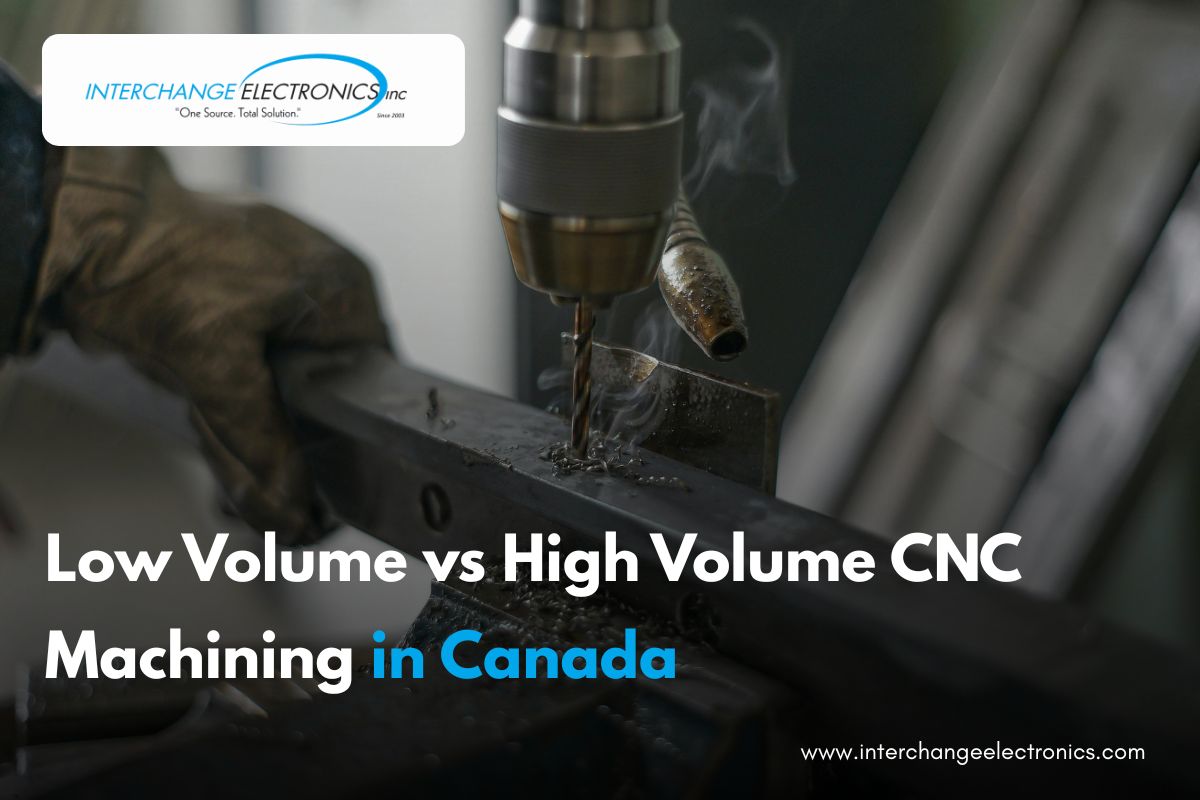
What Is Low Volume CNC Machining?
Low volume CNC machining refers to small-scale production runs, typically ranging from a few units to several hundred parts. It is commonly used for prototyping, product testing, custom components, and early-stage production.
Many businesses choose low volume CNC machining Canada services when they need flexibility, quick design iterations, or specialized manufacturing support without committing to mass production.
This manufacturing approach is ideal for:
- Product startups
- Prototype development
- Custom industrial parts
- Medical devices
- Specialized electronic enclosures
- Market testing before scaling
One of the biggest advantages of low-volume production is agility. Engineers can quickly modify designs, improve functionality, and test real-world performance without major tooling investments.
For businesses entering new markets, small batch CNC machining also reduces inventory risks and prevents overproduction.
What Is High Volume CNC Machining?
High volume CNC machining focuses on large-scale manufacturing where thousands or even millions of identical parts are produced efficiently and consistently.
Unlike prototype manufacturing, high volume CNC machining prioritizes:
- Production speed
- Automation
- Consistency
- Lower per-unit costs
- Long-term scalability
Industries such as automotive, aerospace, industrial equipment, and electronics heavily rely on high volume CNC machining services Canada providers to maintain consistent quality while meeting large production demands.
Modern CNC systems now integrate:
- Multi-axis automation
- Robotic loading systems
- AI-assisted monitoring
- Real-time quality inspections
These technologies allow manufacturers to improve throughput while reducing operational errors.
In Canada’s growing industrial manufacturing sector, scalable CNC production has become critical for OEMs looking to compete globally.
Key Differences Between Low Volume and High Volume CNC Machining:
Understanding the operational differences helps businesses choose the right production model.
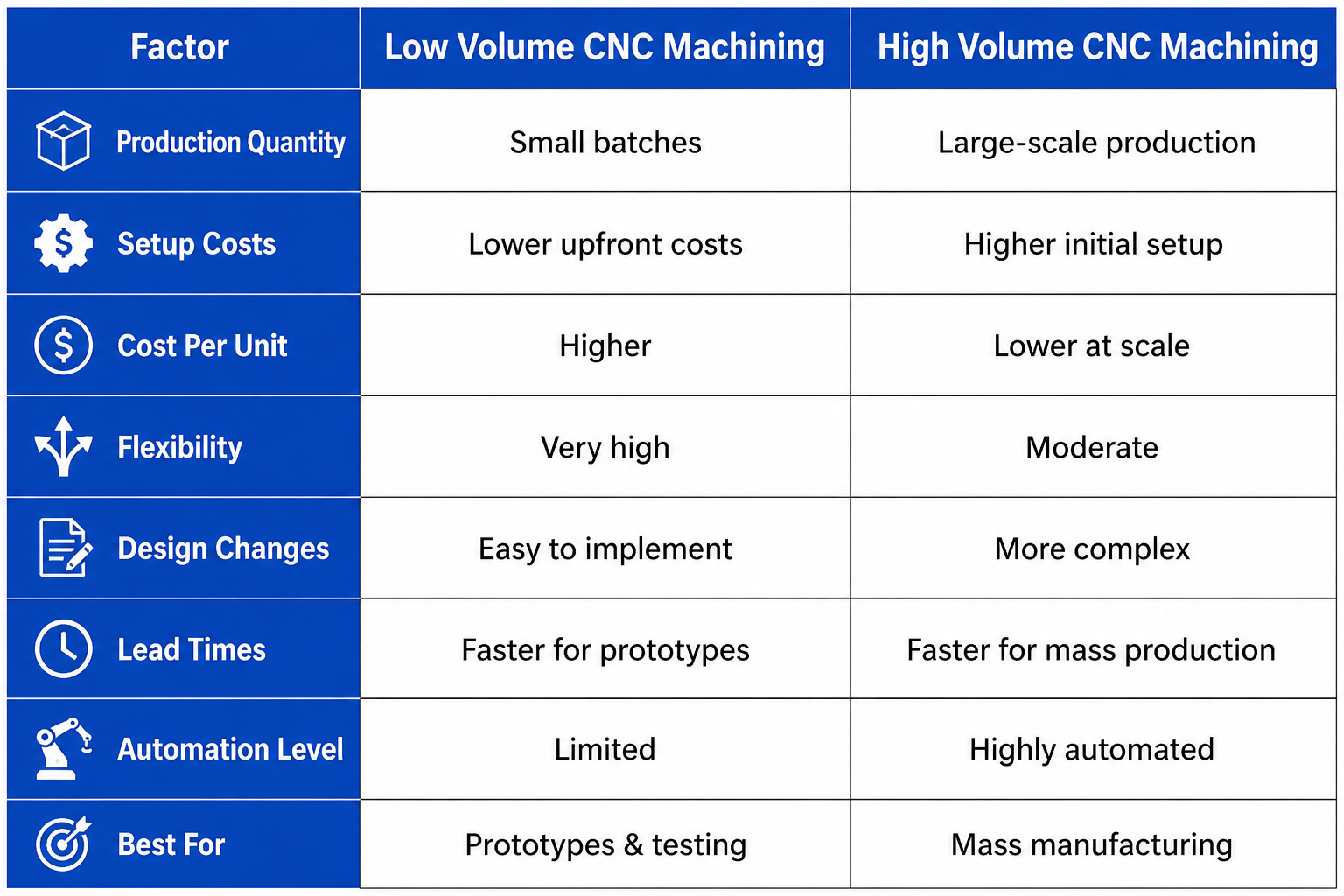
When evaluating low volume vs high volume CNC machining, businesses should consider not only production cost, but also scalability, product lifecycle stage, and market demand.
Advantages of Low Volume CNC Machining:
Faster Product Development:
Low-volume production helps companies move from concept to market faster. Instead of waiting months for tooling and large-scale production setup, manufacturers can rapidly produce functional prototypes.
This is especially valuable in industries where speed-to-market determines competitive advantage.
Lower Initial Investment:
One major benefit of low volume CNC machining Canada services is reduced upfront cost. Businesses avoid expensive tooling and inventory commitments during early development phases.
For startups and small manufacturers, this significantly lowers financial risk.
Easier Design Modifications:
During product development, design changes are common. Small production runs allow engineers to improve functionality, reduce defects, and optimize manufacturing efficiency without major disruptions.
This flexibility is one reason many businesses prefer small batch CNC machining during early production stages.
Reduced Inventory Risks:
Producing smaller quantities helps businesses avoid excess inventory and warehouse costs.
Instead of manufacturing thousands of units upfront, companies can scale gradually based on market demand.
Advantages of High Volume CNC Machining:
Lower Cost Per Unit:
As production increases, setup and operational costs are spread across larger quantities. This significantly lowers per-unit manufacturing expenses.
For businesses with stable product demand, High volume CNC machining becomes far more cost-efficient over time.
Better Production Consistency:
Consistency is critical in industrial manufacturing.
Advanced automation systems improve dimensional accuracy, repeatability, and overall precision CNC manufacturing performance.
This is particularly important for:
- Aerospace components
- Medical devices
- Automotive systems
- Electronics manufacturing
Higher Manufacturing Efficiency:
Modern CNC production lines can run continuously with minimal downtime.
Automation technologies improve:
- Throughput
- Material efficiency
- Production speed
- Workflow optimization
This is why many OEMs work with specialized high volume CNC machining services Canada providers capable of supporting scalable manufacturing operations.
Long-Term Scalability:
Mass production environments are designed for long-term growth.
As demand increases, manufacturers can scale operations without dramatically increasing production costs.
When Should Businesses Choose Low Volume CNC Machining?
Low-volume production is ideal when:
- Developing prototypes
- Testing product-market fit
- Producing custom industrial components
- Manufacturing specialized equipment
- Launching new products
Many startups and innovators use small batch CNC machining before transitioning to large-scale production.
It allows businesses to validate designs while maintaining tighter budget control.
When Does High Volume CNC Machining Make More Sense?
High-volume manufacturing becomes more practical when:
- Product demand is stable
- Large contracts require consistent supply
- Unit cost reduction becomes critical
- Supply chains need scalability
- Production consistency is essential
Large OEMs often partner with a reliable CNC machining company for OEMs to streamline production and improve operational efficiency.
Cost Considerations for CNC Machining in Canada:
Production costs vary based on:
- Material selection
- Machine complexity
- Production volume
- Labor requirements
- Quality control standards
Here’s a simplified cost trend overview:
| Production Type | Cost Trend |
| Prototype Runs | Higher per-unit cost |
| Medium Batch Production | Moderate |
| High Volume Production | Lower long-term unit cost |
For example:
- Aluminum machining is generally more affordable than stainless steel machining
- Multi-axis machining increases setup costs but improves precision
- Automation reduces labor expenses in large-scale production
Businesses focused on precision CNC manufacturing often invest more in process optimization and inspection systems to ensure reliability.
Why CNC Machining Quality Control Matters?
Inconsistent tolerances and manufacturing defects can lead to:
- Product failures
- Warranty claims
- Delayed production
- Customer dissatisfaction
That’s why strong CNC machining quality control processes are essential.
Modern manufacturers use:
- Coordinate Measuring Machines (CMM)
- Automated inspection systems
- Digital process monitoring
- Statistical quality control methods
Strong CNC machining quality control helps manufacturers maintain accuracy, reduce waste, and improve product reliability.
This becomes especially important in aerospace, electronics, automotive, and medical manufacturing sectors where precision standards are extremely strict.
How to Choose the Right CNC Manufacturing Partner in Canada?
Selecting the right manufacturing partner affects everything from product quality to supply chain reliability.
When evaluating a CNC machining company for OEMs, businesses should consider:
- Production capabilities
- Material expertise
- Scalability
- Quality certifications
- Lead times
- Engineering support
- Communication processes
A trusted Canadian manufacturing partner should also provide flexibility between prototype and full-scale production.
Why Production Strategy Matters More Than Most Businesses Think?
Poor production planning often creates hidden costs that businesses overlook.
Common issues include:
- Excess inventory
- Production delays
- Material waste
- Inconsistent quality
- Limited scalability
Choosing the wrong manufacturing approach can slow growth and reduce profitability.
That’s why understanding Low volume vs high volume CNC machining is not just a manufacturing decision it’s a business strategy decision.
Companies that align production methods with actual market demand often achieve:
- Faster product launches
- Better operational efficiency
- Lower long-term costs
- Stronger customer satisfaction
Final Thoughts:
There is no one-size-fits-all answer when comparing Low volume vs high volume CNC machining.
Low-volume production offers flexibility, faster development, and lower upfront investment, while high-volume manufacturing delivers scalability, consistency, and long-term cost efficiency.
The right choice depends on your:
- Product lifecycle stage
- Budget
- Market demand
- Production goals
- Scalability needs
Working with an experienced Canadian manufacturing partner can help businesses optimize production while maintaining high quality standards.
If you’re looking for reliable CNC machining support, Interchange Electronics provides scalable manufacturing solutions ranging from prototype development to full-scale production. Their expertise in industrial manufacturing, quality control, and precision engineering helps businesses build smarter and scale with confidence.
FAQs
Is low volume CNC machining more expensive per unit?
Yes. Because setup and programming costs are distributed across fewer parts, low-volume production generally has a higher per-unit cost.
What industries use high volume CNC machining in Canada?
Automotive, aerospace, medical, industrial equipment, and electronics manufacturing industries commonly rely on large-scale CNC production.
Why is precision important in CNC manufacturing?
Precision ensures components meet exact tolerances, improving product reliability, safety, and long-term performance.
Can one manufacturer support both prototype and mass production?
Yes. Many Canadian CNC manufacturers provide scalable services ranging from prototyping to high-volume production support.