Modern OEMs don’t just need manufacturers. They need reliable production partners capable of delivering precision, consistency, scalability, and speed without compromising quality.
That’s exactly why demand for Custom metal CNC machining services in Canada continues to grow across industries like electronics, aerospace, automotive, robotics, and industrial automation. As products become more advanced and tolerances become tighter, manufacturers need machining solutions that can keep up with engineering demands.
From rapid prototyping to full-scale production, CNC machining has become one of the most dependable manufacturing methods for OEMs looking to improve quality, reduce production risks, and maintain supply chain stability.
In this blog, we’ll explore how CNC machining services Canada support OEM manufacturing, what benefits they offer, and what businesses should look for when choosing the right machining partner.
What Are Custom Metal CNC Machining Services?
Custom metal CNC machining services use computer-controlled manufacturing equipment to create precision-engineered metal components based on exact specifications. These services help OEMs produce accurate, repeatable, and scalable parts for industrial applications.
Unlike traditional machining, CNC systems automate cutting, drilling, milling, and shaping processes with extremely high precision. This makes CNC machining ideal for industries where even minor dimensional inconsistencies can lead to performance failures.
How CNC Machining Works?
The process begins with CAD (Computer-Aided Design) software where engineers create detailed part models. CAM (Computer-Aided Manufacturing) software then converts these designs into machine instructions.
CNC machines follow these instructions automatically to shape raw metal into finished components with tight tolerances and repeatable accuracy.
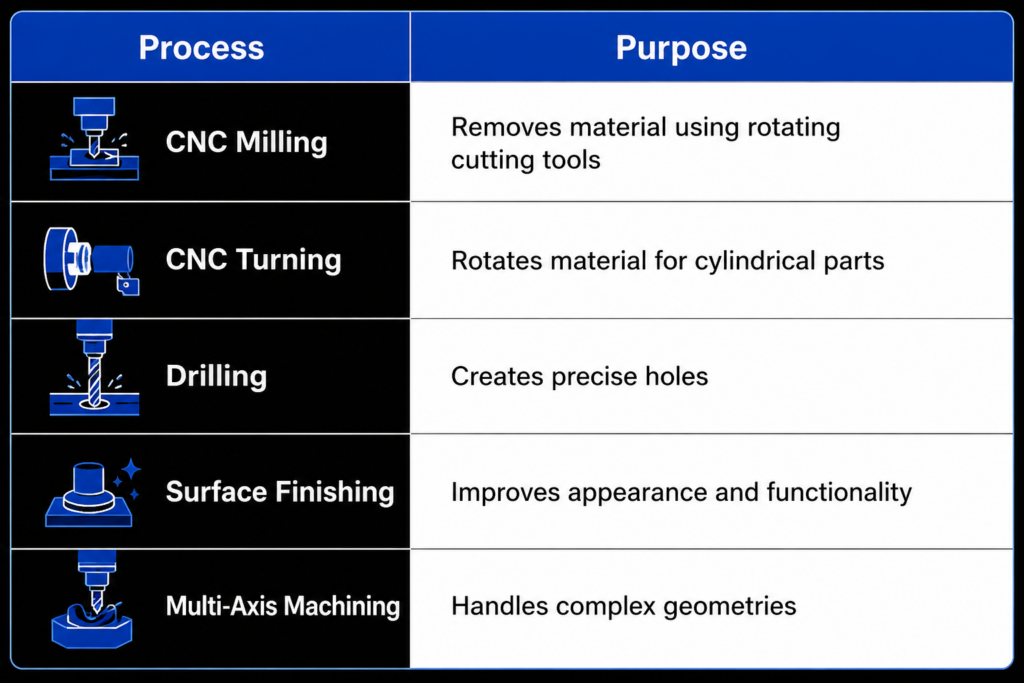
Common CNC Machining Processes:
Common Metals Used in CNC Machining:
Different industries require different material properties such as corrosion resistance, conductivity, strength, or weight reduction.
Frequently Used Metals:
| Metal | Common Applications |
| Aluminum | Electronics housings, aerospace parts |
| Stainless Steel | Medical devices, industrial equipment |
| Brass | Connectors, fittings, electrical components |
| Copper | Conductive industrial applications |
| Titanium | Aerospace and high-performance industries |
The flexibility of these materials makes Metal CNC machining for OEMs highly adaptable across multiple manufacturing sectors.
Why OEMs Choose CNC Machining for Manufacturing?
OEMs rely heavily on precision manufacturing because product quality directly impacts brand reputation, reliability, and operational performance.
High Precision and Tight Tolerances:
Modern CNC systems can achieve tolerances as tight as ±0.001 inches, making them suitable for highly sensitive applications.
This level of precision is especially important in:
- Aerospace systems
- Medical equipment
- Automotive assemblies
- Electronics manufacturing
- Robotics
For OEMs, consistency across thousands of parts is critical. CNC automation minimizes human error and improves repeatability.
Scalable Production Capabilities:
One of the biggest advantages of OEM CNC machining services is scalability.
Manufacturers can move from:
- Prototype production
- Small-batch manufacturing
- Mid-volume production
- Large-scale manufacturing
without needing entirely different production systems.
This flexibility allows OEMs to scale operations faster while maintaining product consistency.
Faster Product Development:
Speed matters in manufacturing.
According to Deloitte’s 2025 manufacturing report, companies reducing product development timelines by 20% often gain a major competitive advantage in industrial markets.
CNC machining helps accelerate production through:
- Rapid prototyping
- Automated workflows
- Reduced setup time
- Faster repeat production
OEMs can test, refine, and launch products faster.
Improved Product Reliability:
Precision machining improves:
- Structural consistency
- Mechanical performance
- Assembly compatibility
- Long-term durability
Reliable manufacturing directly reduces:
- Product failures
- Rework costs
- Warranty claims
- Production downtime
Industries That Depend on CNC Machining Services in Canada:
Many industries now rely on Canadian CNC machining services because of growing quality standards and supply chain reliability concerns.
Major Industries Using CNC Machining:
| Industry | CNC Machining Applications |
| Electronics | Heat sinks, enclosures, connectors |
| Automotive | Engine parts, brackets, precision components |
| Aerospace | Lightweight structural parts |
| Medical | Surgical equipment components |
| Robotics | Precision mechanical assemblies |
| Industrial Automation | Machine components and frames |
The growth of OEM component manufacturing in Canada has also increased demand for localized production support.
Key Advantages of Working With a Canadian CNC Machining Partner:
Working with local manufacturing partners provides advantages beyond production itself.
Better Supply Chain Stability:
Global disruptions over the last few years forced many OEMs to reconsider overseas manufacturing dependencies.
Canadian manufacturers help businesses:
- Reduce shipping delays
- Improve communication
- Lower logistics risks
- Strengthen supply chain resilience
According to Statistics Canada, Canadian manufacturing exports exceeded CAD $354 billion in recent years, showing continued industrial growth and investment.
Faster Communication and Collaboration:
Manufacturing problems become expensive when communication is slow.
Working with local CNC providers allows:
- Faster engineering discussions
- Easier design revisions
- Better project visibility
- Faster troubleshooting
This becomes especially valuable during product development stages.
Faster Shipping and Lead Times:
Domestic production often reduces:
- International freight delays
- Customs complications
- Long shipping timelines
For OEMs operating on tight production schedules, lead time reductions can significantly improve operational efficiency.
Strong Quality and Compliance Standards:
Many CNC fabrication services providers in Canada operate under strict quality control procedures and industrial standards.
This helps OEMs maintain:
- Product consistency
- Regulatory compliance
- Better inspection accuracy
- Manufacturing traceability
Important Factors OEMs Should Consider Before Choosing a CNC Machining Company:
Not all machining providers offer the same capabilities.
Choosing the wrong partner can result in:
- Production delays
- Quality inconsistencies
- Increased costs
- Supply chain disruptions
Key Factors to Evaluate:
| Factor | Why It Matters |
| Multi-Axis Capabilities | Supports complex parts |
| Material Expertise | Ensures better machining results |
| Quality Control Systems | Reduces defects |
| Scalability | Supports future growth |
| Engineering Support | Improves manufacturability |
| Industry Experience | Reduces production risks |
If you’re evaluating manufacturing costs as part of supplier selection, this detailed guide on Cost of Metal CNC Manufacturing in Canada: What to Expect explains major pricing factors affecting CNC production.
You should also review this helpful resource on How to Choose a Reliable Metal CNC Manufacturing Company before selecting a long-term production partner.
Challenges OEMs Face Without Reliable CNC Machining Support:
Poor manufacturing support often creates operational problems that impact profitability.
Common CNC Manufacturing Problems:
| Poor CNC Partner | Reliable CNC Partner |
| Inconsistent tolerances | Precision-controlled machining |
| Production delays | Predictable timelines |
| Weak communication | Transparent project coordination |
| High defect rates | Strong quality assurance |
| Limited scalability | Flexible production capacity |
Even small manufacturing inconsistencies can create major downstream issues in assembly and product performance.
How Advanced CNC Machining Improves Manufacturing Efficiency:
Automation has transformed modern machining operations.
Advanced CNC systems now improve:
- Accuracy
- Production speed
- Material utilization
- Cost efficiency
Automation Reduces Human Error:
Automated machining reduces variability caused by manual operations.
This improves:
- Dimensional consistency
- Repeatability
- Process reliability
Better Material Utilization:
Modern CNC systems optimize cutting paths to reduce material waste.
This helps OEMs:
- Lower raw material costs
- Improve sustainability
- Increase production efficiency
Faster Repeat Production:
Once machining programs are configured, repeat production becomes significantly faster.
This is especially useful for:
- Recurring OEM orders
- Production scaling
- Long-term manufacturing contracts
Long-Term Cost Efficiency:
While precision machining may appear expensive initially, reliable CNC manufacturing often reduces total production costs over time through:
- Lower defect rates
- Reduced rework
- Better product lifespan
- Improved operational efficiency
Why OEMs Partner With Interchange Electronics for CNC Machining Services?
OEMs need more than machining capacity. They need dependable manufacturing support capable of maintaining quality and consistency at every stage of production.
Interchange Electronics supports businesses with precision-focused manufacturing solutions designed for scalability, reliability, and long-term production efficiency.
What OEMs Look For in a Manufacturing Partner?
- Precision-driven machining
- Quality-controlled workflows
- Scalable manufacturing support
- Engineering collaboration
- Reliable production timelines
- Industrial manufacturing expertise
Whether businesses require prototypes, low-volume production, or ongoing Industrial component manufacturing, working with an experienced CNC manufacturing partner helps reduce production risks while improving product reliability.
Final Thoughts:
As manufacturing becomes more competitive, OEMs need production partners that can deliver precision, scalability, and operational consistency.
That’s why demand for Custom metal CNC machining services in Canada continues to rise across industrial sectors.
From improved quality control to faster production timelines, CNC machining helps businesses manufacture high-performance components with greater confidence and efficiency.
For OEMs looking to strengthen production reliability, improve manufacturing scalability, and support long-term growth, investing in the right machining partner can make a major difference.
FAQs
What industries use custom CNC machining services?
Industries such as aerospace, automotive, electronics, robotics, industrial automation, and medical manufacturing commonly rely on CNC machining for precision metal components.
What metals are commonly used in CNC machining?
Common metals include aluminum, stainless steel, brass, copper, titanium, and carbon steel depending on application requirements.
Why is CNC machining important for OEMs?
CNC machining helps OEMs achieve precision, consistency, scalability, faster production, and reduced manufacturing errors for complex industrial components.
How do I choose the right CNC machining company in Canada?
OEMs should evaluate manufacturing capabilities, quality control systems, material expertise, scalability, lead times, and industry experience before choosing a CNC machining partner.